Thursday, March 26, 2015

Google Apps for the Classroom

The use of Google Apps in a school setting can be used between students and teachers to collaborate, communicate, synthesize, analyze, create projects and so much more!   Anyone can sign-up for a Google account and once that is done the possibilities endless .  Google has a website, Google for Education, that allows educators, students and parents to explore all the benefits of incorporating Google Apps into their school setting.  The great aspect about Google Apps is that they can be used between teacher and student, student to student, or teacher to all students.  Not only will the students be engaged because they are collaboratively working together but they are also doing something they enjoy: Communicating with one another on their device’s.  There is no worry about printing or saving documents because everything is easily stored in a user’s Google Drive, which is pretty much like a USB that you can access from any device.  Perhaps the best feature of Google Apps for education is the fact that they are all free!

In my own school, all students starting in fourth grade are set up with a Gmail account through the school’s technology teacher.  This way they are prepared to start sharing and collaborating on documents once they get to middle school.  The teachers have also been using Google Apps for sometime now.  Often the Principal will share a document or notice that she may need editing on what us to review.  This is a fast and efficient way to get the message out without copying and wasting paper.  I personally love Google Apps and have been using it for about two years now.  I just love the ease of access to all my files and the user-friendliness the applications.  


Survey Results (Using Google Forms)


Sunday, March 15, 2015

Social Media in the Classroom: Pros and Cons

In today's world of educational debates, there is a focus on whether social media can be a useful tool when integrated into the classroom.  Here is my pros and cons list as to the use of social media in the classroom:

Pros:
The use of social media allows students to collaborate and connect with one another outside of the classroom walls.  This is particularly important when talking about group projects and assignments.   With the use of social media, students are no longer restricted to their class period to work on things together.  Social media also allows others to comment and share thoughts on projects allowing for an environment more similar to the work environment.  The use of social media may also allow parents to stay connected to what is going on in the classroom.  Applications like Remind and Edmodo, make it easy for teachers to get an important message out to parents or to students.  

Cons: 
When using social media in the classroom, the teacher must also take on the role of moderator to make sure what students are posting is appropriate.  This can take time to go through and check.   With social media comes cyberbullying and the worry that students are using social media in inappropriate ways.  Again, this would fall on the teacher to ensure that students are aware of consequences and what is considered a "good" post versus a "harmful" post.  Then there is the whole other issue that students are not getting the right amount of time communicating face-to-face, both with peers and with family.  Adding the social media component to their school day may hinder this face-to-face communication during afterschool hours.  Finally, not all children have access to the internet or a device let alone the ability to connect to a peer via a social networking site.    

Friday, February 20, 2015

Digital Citizenship-Never Too Early To Begin

http://mattbgomez.com/we-should-be-doing-more-than-teaching-digital-citizenship/

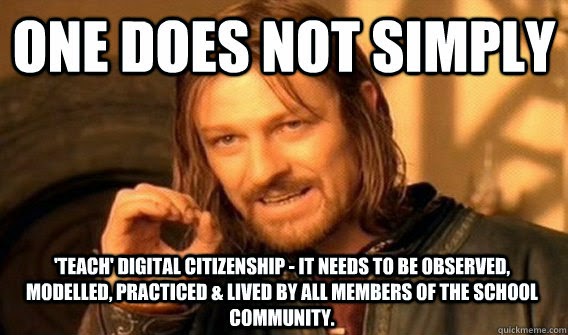
Digital citizenship, in my opinion, should be taught early and often.  If I could have it my way, as young as kindergarten when we start teaching the students concepts of “stranger danger”.  Let’s be honest, these kids are on the internet whether we want to believe it or not at this young age anyways.  The concept of knowing how to act and behave online can be overlooked by many teachers or adults with the simple assumption that the children know how they should behave and act.  In my own experience, many times I have also overheard “teacher room talk” with suggestions that perhaps the parents need to look at their child and what they are doing online.  The blame can be put on all sorts of people, but that will not solve the matter at hand of how do we teach children the importance of protecting themselves through respecting themselves online?  I feel that there is a strong need for children to learn what their digital footprints implies, how it can follow them their whole life, and how to protect it.  

http://www.quickmeme.com/meme/3rgi6e
As far as my own digital footprint is concerned, I try to stay private about most things and avoid posting images of myself/social life.  I do have this blog of course for professional and educational purposes, and I also have a Twitter for the same purposes,l as well as to stay up-to-date on current events and news.  However, I steer clear of photo sharing sites such as Facebook and Instagram.  Don’t get me wrong, I understand how some people use these social sites to stay in touch with friends and family or for other means, but it’s just not for me.  I know that somewhere out there in “internet database world” there are images of me, but nothing that I must say I regret or would pose a threat for me.  Now I understand what people could do with these photos could pose a potential threat but that is where an individual must take a stand and be proactive about what it is they want people to know about them via the world wide web and keep a watchful eye.  

Sunday, February 15, 2015

The role of a technology integration specialist....

This will be my second course here at SNHU focused toward on the field of being a technology integration specialist.  My first course here had me hooked and diving right into using technology in the classroom.  Then came the educational courses, though full of great information and strategies, did not focus on the role of technology in the classroom.  Either way, knowing that this was my passion, I was able to incorporate it as best as I could.  Using technology and technological concepts within my action research projects.   Going back to my first course, my professor was a technology integration specialist which was was a rewarding experience because I got to hear of some of her challenges and triumphs in the field.   Over time I have come to look at the role of a technology specialist as someone who collaborates with others on a daily basis in order to provide tips and strategies focused on the integration of technology in the classroom.  They are the one's doing the research behind the scenes of what is most effective and what just simply will not work for the school/district in terms of time, commitment and financial restraints.  Then, this takes away the burden of classroom teachers having to do the research all themselves, while still planning lessons, grading student work, and researching their own instructional areas.  

As far as today's students, they are rapidly exploring and using technology in more ways than most people can imagine.  Unlike some adults who may be timid to dive into technology, today's students are curious.  They are not afraid to "break" something per se, but rather they want to learn how to build it back up.  In my own experience I have found that of course there are some challenges though.  That is why it is up to technology educators to seek answers to these issues.  Elsewhere others are dealing with the some of the same issues and that is where we must research effective ways before we deem the technology ineffective or problematic.  
I think the role of today's teacher is to continue to look for and seek out new ideas to transform their classrooms.  Perhaps this is why some are so afraid to step out of their "comfort-zone" and build that wall up between adapting their lesson and sticking with what they know.